A Press Release With a Trapdoor
Washington announced a deal, rewrote it in the final hours, then taxed Canada fifty per cent for refusing to sign. Only one side won't release the text.

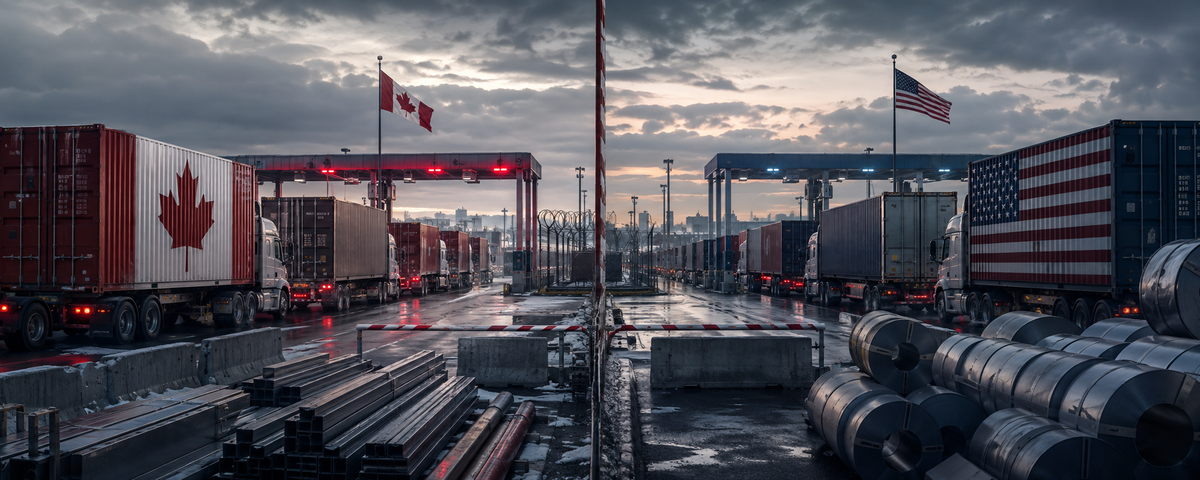
The United States spent a week telling the world it had a deal with Canada. Then it rewrote the terms in the final hours, and when Ottawa refused to sign, it taxed a neighbour at fifty per cent for the offence of saying no.
That is the whole story, and no amount of trade-desk vocabulary softens it.
The deal that was announced before it existed
On Aug. 18, the White House declared an agreement reached, subject to documentation, and paused the tariffs for three days. On Aug. 19, U.S. Trade Representative Jamieson Greer told reporters in Washington he was confident a deal had been struck and that the major irritants had been resolved. Canada's negotiators stayed at the table all week.
Then, in the last hours, the American side introduced new terms. Prime Minister Mark Carney suspended negotiations on Aug. 21 and recalled his team, calling the new terms uneconomic and unfair. At midnight the tariffs landed anyway.
An agreement that can be announced, celebrated and then quietly rewritten before signature is not an agreement. It is a press release with a trapdoor. Any government watching this episode has now learned exactly what an American commitment is worth at the documentation stage.
A dead letter from 1930, dusted off for a neighbour
The tariffs were imposed under Section 338 of the Tariff Act of 1930 — a provision permitting duties of up to 50 per cent on trading partners judged to discriminate against American commerce. It sat unused for ninety-six years. It has now been fired, for the first time in its existence, at the country that supplies the American economy with most of its imported energy.
The Washington Post described the manoeuvre as an untested legal power deployed to force concessions. That is the polite construction. The blunter one: the administration went rummaging through the statute book of the Smoot-Hawley era looking for a weapon that had never been tried, because the weapons that had been tried were not producing surrender fast enough.
What Washington actually asked for
Carney named three late American changes. Each is worth reading slowly.
The auto provisions. The U.S. sought to redraw the scope of tariffs on Canadian auto content, treating Canadian-made parts unfavourably and exempting some cars and pickup trucks while excluding others — with, Carney said, no explanation offered for the distinction. Unexplained, discretionary carve-outs are not trade policy. They are a dial in someone else's office, and whoever holds it decides which Canadian plants have a future.
The third-country restriction. American negotiators introduced language that would have limited Canada's ability to make trade agreements with other countries. Canada has signed more than twenty trade and security arrangements in the past year — precisely the diversification that its dependence on the American market makes necessary. Washington's proposal was to shut that door and then keep the leverage that the closed door creates.
This is the demand that ends the argument about whether this was ordinary hard bargaining. A country may set any condition it likes on goods entering its own market. It has no business dictating which agreements its neighbour may sign with third parties. British Columbia Premier David Eby said accepting it would have left Canada "the economic equivalent of the 51st state." He was not being colourful. He was describing the clause.
Language and culture. The Americans objected to Canadian subsidies for French-language culture, to the prominence of French-language media online, and to Canada's requirement that products carry bilingual labels.
Read that last item again. The government of the United States, in a trade negotiation with an ally, spent its final hours of leverage trying to get French off the side of a cereal box. Carney said the demand was unacceptable from the start, that the Americans kept pressing, and that these issues were "never on the table."
There is no serious commercial theory under which bilingual labelling in Quebec threatens American industry. There is only the reflex of a government that has stopped distinguishing between a trading partner's regulations and a subordinate's habits.
Canada moved. Washington pocketed it and asked for more.
Ottawa was not intransigent. Carney said Canada was prepared to drop its remaining retaliatory tariffs on steel, aluminum and autos if the U.S. substantially lowered its own; to encourage the provinces to put American alcohol back on store shelves; and to make administrative changes around dairy supply management without touching the system, the quotas or the tariffs.
Those are real concessions with domestic political costs attached. They were met with a longer list. Carney's summary — that the Americans "asked too much and offered too little" — is the most restrained sentence any Canadian prime minister has produced this year.
Washington's version, and what it does not answer
Greer's account differs. He said Canada "declined to finalize the trade deal under the terms agreed earlier this week," blaming new Canadian demands and walked-back commitments, and noted that Ottawa still bars certain American goods and services. He said the American offer would have included aerospace supply-chain coordination, cooperation on critical minerals, enforcement against forced-labour imports and the formal launch of CUSMA negotiations. Afterward he told Fox News: "We don't have new talks planned with the Canadians."
Take that account at face value and it still does not touch the objection. Nothing in aerospace coordination or mineral cooperation explains why the United States needed authority over Canada's future trade agreements, or an opinion about French-language broadcasting. Those demands are either in the text or they are not, and only one government is refusing to publish it.
Which is the tell. Washington's account of its own generosity would be trivially easy to prove. Release the document.
The hostage economy
The strategy here is not subtle: build the dependence, then charge rent on it. Roughly three-quarters of Canadian goods exports went to the United States as recently as 2024. That share has been falling fast — about 72 per cent in 2025, and into the mid-to-high sixties by early 2026, according to Scotiabank Economics — and Global Affairs Canada reports the non-U.S. share of exports hit 32.8 per cent last year, its highest in more than four decades.
Diversification is real, if narrower than the headline numbers suggest; much of it is gold, crude and critical minerals rather than a broad wave of new exporters. But the direction is unmistakable, and it explains the third-country clause perfectly. Washington did not object to Canadian dependence. It objected to Canadian dependence ending.
Who actually pays
The duties hit wine and spirits, furniture, cement, plywood, building materials, clothing, fishing rods and hockey equipment. American consumers will pay them, because that is how tariffs work, whatever the podium says.
The U.S. Chamber of Commerce warned before the collapse that higher tariffs would damage both economies and put at risk the 13 million American jobs tied to the North American trade pact. Canada's Chamber of Commerce called the outcome a blow to continental competitiveness. Neither organisation is a Canadian nationalist front. Both are telling the administration that it is shooting into its own supply chain.
Canada's counter-tariffs arrive Sept. 8 — steel, dairy, appliances, agricultural equipment, pulp and paper, electronics. Canadians will pay for those. Nobody in Ottawa is pretending otherwise, which is more than can be said for the other side of the border.
The agreement they would not renew
Lost in the week's noise: at the 2026 joint review, the United States declined to renew CUSMA for a further sixteen-year term. The pact survives on annual reviews until 2036 unless someone withdraws. A country that will not commit to a continental agreement for more than twelve months at a time, while demanding permanent constraints on its neighbour's foreign trade policy, has explained its intentions clearly enough.
What is still unverified
A graphic circulating online lists thirteen alleged American demands — infrastructure control, priority access to energy and critical minerals, pharmaceutical patent extensions, military procurement conditions, the abolition of "Buy Canada" rules. It is unconfirmed and should not be treated as fact.
Reporting before the collapse pointed to a shorter list. The Globe and Mail, citing sources on both sides, described roughly ten U.S. demands covering retaliatory tariffs, alcohol, dairy and procurement, with defence and critical minerals deferred to later phases.
The confirmed demands are damning enough. Inventing extras only hands Washington an easy rebuttal. Conservative MP Shuvaloy Majumdar has asked the government to release the full text of the rejected proposal, and he is right to. Canadians were asked to absorb a trade war on the strength of this document. They are entitled to read it.
Sovereignty is only worth something when it costs something
Canada will pay for this. Jobs, investment, prices, border towns, whole sectors. That should be stated plainly rather than dressed up as a flag-waving triumph.
But the alternative on offer was not cheaper trade. It was a country that keeps its Parliament, its elections and its flag while another government decides which agreements it may sign, which factories may survive, and which language may appear on a label.
Canada was not asked to compromise. It was asked to report.
It declined.