There Is No Tariff Rate At Which We Forget We're Canadian
Trump's plan to annex Canada requires taxing American car parts, threatening American fertilizer, and destabilizing American oil until 42 million Canadians fall in love with him. It's the dumbest strategy ever attempted by a man who declared total victory in a war that's still killing Americans.

Donald Trump's plan to annex Canada requires punching America in the mouth until Canadians fall in love with him. It is the single dumbest strategy ever attempted by a man who once declared total victory in a war that is still killing Americans.
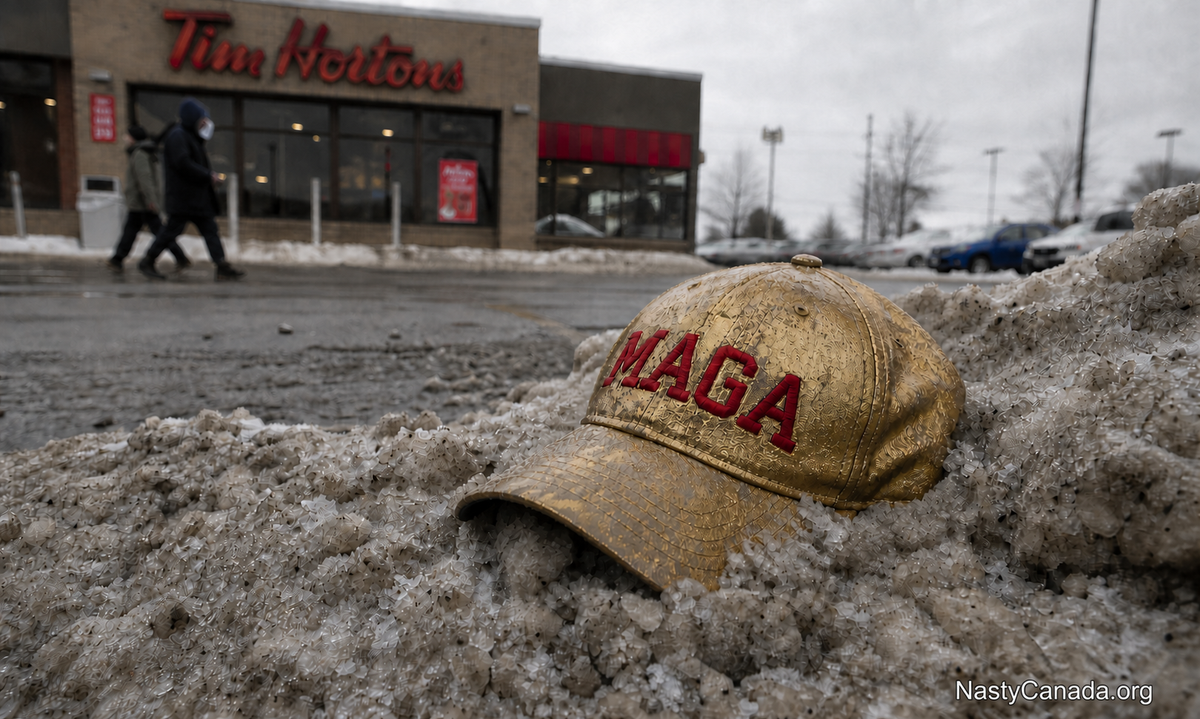
Feature image concept: A gold-plated MAGA hat sitting in a snowbank outside a Tim Hortons, half-buried, one flap frozen upright. Grey Ontario sky. Nobody has bothered to pick it up.
Trump's plan for Canada has finally come into focus, and it turns out he intends to conquer the country the way a toddler conquers a supermarket aisle — drop to the floor, scream, throw whatever's in reach, and assume the exhausted adults will eventually give in just to make the noise stop. The only meaningful difference is that most toddlers don't control the world's largest economy, don't have a nuclear arsenal, and haven't threatened to dismantle another country's auto sector because its people declined to start calling their Prime Minister “Governor.”
This stopped being a trade dispute a long time ago. All the familiar noise about dairy quotas and aluminum and softwood and steel and booze and farm access — that's camouflage now, thrown over something considerably uglier. The final American demands reportedly included restrictions on Canada's ability to sign future trade agreements with anybody else, concessions touching French-language protections and Canadian cultural policy, and terms that Mark Carney says would slowly strangle Canadian automobile production until it wandered south on its own. When Canada said no, Trump instructed Canadian leaders to “fall in line” or face consequences “far WORSE” than the tariffs already in place.
The capitals are his. The man genuinely appears to believe international diplomacy should read like a text message composed by someone being escorted out of a casino buffet.
He's now threatening 50 percent tariffs on Canadian cars, trucks, auto parts and steel starting January 1, 2027, and Carney has said plainly what the objective is: destroy Canada's major industries or relocate them, and treat the country as a subsidiary rather than a sovereign nation. Trump, for his part, has complained that “Canada wants the benefits of being a State, without being one!!!” — three exclamation marks, because where other governments deploy ambassadors and evidence and signed agreements, Trump simply leans on the punctuation until a lie gets promoted to foreign policy.
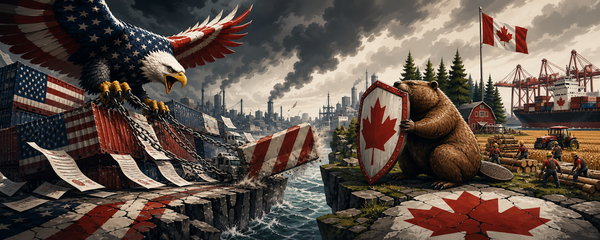
All of which follows his earlier announcement that he'd use “economic force” to make Canada the 51st state. Fifty percent tariffs are already sitting on roughly $20 billion in Canadian goods. Canada is loading its own.
You cannot prove every tariff is part of a meticulous annexation strategy, largely because Trump has never in his life concentrated on anything long enough to build one. His policies arrive like debris off an overloaded garbage truck — loud, badly secured, dangerous, and nobody's fault the moment they hit the highway. But the connection between the annexation fantasy and the economic beating isn't a theory. He said it out loud. He said he'd use economic force to absorb Canada, and now he's using economic force while whining that Canada is unfairly enjoying the perks of American statehood.
When a man announces he's going to poison your well and then turns up beside it holding a jug marked POISON, you don't need a special counsel to develop a working theory of the case.
He looks north and doesn't see a country. He sees empty space around his own reflection.
Glorious Only Inside His Own Skull
The title “Glorious Leader” exists in exactly two places: inside Trump's head, and somewhere in the warm authoritarian fog rising off him. Outside that sealed little ecosystem, the man is collapsing.
A Reuters/Ipsos poll wrapped August 24 put his approval at 33 percent for the second straight survey — the lowest of either term. Sixty-four percent disapprove. Support for his Iran war has slid to 31 percent from 37 in March, and 83 percent of Americans expect it to grind on indefinitely. Even Republican support for the war has dropped from 77 to 69. Among independents heading into November's midterms, Democrats lead 33 to 19.
This is not a conquering hero bestriding the world. This is a wildly unpopular man rejected by two-thirds of his own country, compensating for political shrinkage by picking on the neighbours. The louder he declares himself victorious, the more obvious it becomes that the applause is a soundtrack playing inside his own skull and nowhere else.
So the trade war isn't being launched from a position of strength. It's being launched by a man walking into midterms with gas more than a dollar higher than before he started bombing Iran, support leaking out of his administration like sewage from a split septic tank, and independents sprinting for the exits. A competent leader in that spot might try stabilizing prices and reassuring allies. Trump has decided to tax auto parts, threaten his own energy supply, antagonize farmers, and start a fight with America's single largest export customer.
This is his idea of changing the subject. It's like distracting people from a kitchen fire by driving a truck through the living room.
The Iran War Was A Catastrophe. This Is Stupider.
Iran was reckless and expensive and built on the usual fantasy that bombing a thing produces whatever political outcome he announces afterward. In April he proclaimed “Total and complete victory. 100%. No question about it.” The war, unfortunately, does not follow his social media account, and carried on regardless.
By August: 18 American service members killed, at least 624 wounded. The Pentagon put direct military costs at $37.5 billion; independent assessments landed between $34 and $42 billion as of June 23. Higher gas and diesel had cost American drivers an extra $87 billion by August 19. Iran still holds a de facto blockade over regional oil exports. Pump prices are near records.
The “total victory” is aging like one of his bankrupt casinos — lights still flashing, owner still bragging, creditors circling the parking lot, and everybody except the man whose name is bolted to the building understands exactly what happened.
But here's the thing: even Iran had objectives you could theoretically write into a treaty. Limits on enrichment. Missile restrictions. Guarantees around Hormuz. He pursued them with the finesse of a drunk assaulting a vending machine, sure, but they were at least concrete asks that could exist on paper.
The Canadian objective is fundamentally more idiotic, because Trump is attempting to use tariffs to convince roughly 42 million people to abandon their nationality, dissolve their constitutional order, hand over a sovereign country, and then apply for membership in the nation currently kicking them in the ribs.
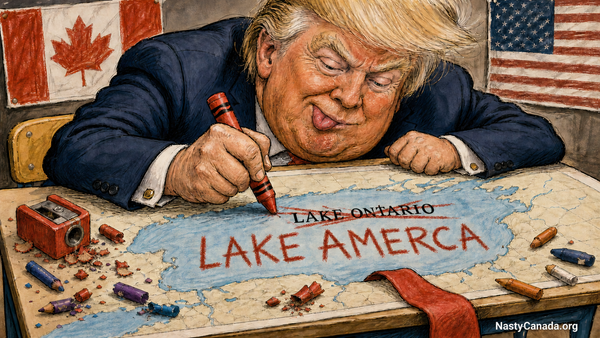
There is no tariff rate at which Canadians suddenly forget they're Canadian. There is no economic model in which gutting Ontario's auto sector causes Windsor to start demanding congressional representation out of Florida. There is no quantity of abuse that convinces Quebec its French-language protections would be safer in the tender custody of Donald Trump and JD Vance.
He thinks national identity works like a delinquent mortgage — apply enough pressure, tank the property value, spook the occupants, and eventually the bank gets the keys. He cannot process that a country is not a failing hotel, that sovereignty is not distressed real estate, and that Canadians are not subcontractors he can stiff until they take twenty cents on the dollar and go away.
Economic pain can force a government to move on a quota. It does not make a population fall in love with its tormentor. Trump is punching Canadians in the face and waiting for the proposal.
The Museum Of Imaginary Accomplishments
He's always been best at achieving things that never happened.
He claimed to have ended six wars, then seven, then eight. Independent reviews found he played some real role in a few ceasefires, but several of the conflicts he listed weren't wars, several remain unresolved, and officials in the countries involved flatly disputed his version. Then he started a fresh war and declared it finished several times while Americans kept dying.
He claims tariffs have produced an economic miracle. In reality, American importers pay the tariffs, American companies eat or pass along the cost, and American consumers get the invoice. Trump then points at money collected from Americans and announces that foreigners paid it — the reasoning of a man who lifts twenty bucks out of his own wallet and congratulates himself on the earnings.
He claims the U.S. “subsidizes” Canada by $200 billion a year. It doesn't. A trade deficit isn't a subsidy, and the numbers aren't remotely close. His own Office of the U.S. Trade Representative recorded a $48.3 billion goods deficit with Canada in 2025 against a $27.7 billion services surplus — a net gap around $20.6 billion. Even generous estimates stuffed with defence spending can't get within shouting distance of $200 billion.
Calling a trade deficit a subsidy is like insisting Americans subsidize Japan every time somebody buys a Corolla. Money goes one way, goods come back the other. Nobody in Saskatchewan is holding a gun on American consumers to make them buy potash. They buy Canadian oil and lumber and fertilizer and electricity and aluminum because they need it and because buying it from us beats every other option available.
He's also claimed Canada does “95% of their business” with the United States and that America doesn't need us. Both die instantly on contact with arithmetic. About 72 percent of Canadian goods exports went south in 2025 — real dependence, not nothing, but not 95 percent of an economy that also contains services, construction, finance, resources, domestic commerce and trade with the rest of the planet. He's taken one big number from one category and inflated it into the whole country, the same way he takes one functioning thought and stretches it across ninety minutes of speech.
And the dependence runs both directions. Two-way trade hit $872.3 billion in 2025. The U.S. exported $333.6 billion in goods and $92.3 billion in services to Canada. We were the top destination for American exports in 2024. Again: his own trade office.
So “America doesn't need Canada” isn't analysis. It's an old man hollering that he doesn't need the staircase, mid-fall.
Tariffs Are Taxes, Not Bags Of Canadian Tribute
He talks about tariffs like Canadian officials will pull up to the White House with leather satchels of gold, bow before the Glorious Leader, and apologize for our health care. That is not how any of this functions.
American importers pay American tariffs. Those firms absorb the hit, squeeze suppliers, buy less, or pass it to American buyers. Not one dollar comes out of Mark Carney's wallet. It gets added to invoices paid by American manufacturers, retailers, builders, farmers and families.
The auto industry makes the stupidity especially vivid, because Canadian and American vehicle manufacturing isn't two separate factories hurling finished cars at each other over the Detroit River. It's one production network. Components cross the border repeatedly before anything reaches a dealership. Taxing Canadian parts raises the cost of American cars.
He is attempting to strengthen American auto manufacturing by making its parts more expensive. This is improving a hospital by putting a tariff on blood.
He's got one hand caught in the Iranian meat grinder and has decided the clever play is inserting the other one into Canada.
Meanwhile Canada ships roughly 4 million barrels of oil a day south, about 60 percent of American oil imports. Around 85 percent of the potash American farmers use comes from here. Ontario exports enough electricity to power something like 1.5 million American homes and businesses. We supply critical minerals that end up in aircraft, electronics, missiles and munitions.
So he's threatening the country that fuels American refineries, fertilizes American farms, feeds American factories and keeps American lights on — while an Iranian blockade already has pump prices flirting with records.
He Is Uniting The Country He Wants To Dissolve
If the goal was weakening Canadian identity, the results are spectacular in the wrong direction.
The threats have welded together federal Liberals, provincial Conservatives, labour, business groups, Quebec nationalists, and Canadians who ordinarily can't agree on whether this country should have an identity at all. Doug Ford — a Progressive Conservative, for anyone keeping score — has backed Carney's refusal and told Canadians to brace for the sacrifice. People have cancelled American trips, pulled American bourbon off provincial shelves, checked labels at the grocery store, and demanded Ottawa hit back harder.
Even separatism has softened. Support for Quebec sovereignty has fallen to roughly 30 percent, with a lot of Quebecers deciding that Canadian unity is the more urgent project while Washington takes runs at French-language protections.
The man trying to dissolve Canada has made Quebec keener on staying in it. That's not a strategic failure. That's the geopolitical equivalent of trying to drown somebody and accidentally teaching them the front crawl.
An Angus Reid survey found 79 percent of Canadians view Trump unfavourably, 69 percent very unfavourably. Meanwhile 59 percent of Americans oppose the new Canadian tariffs against 24 percent in favour, and 78 percent think their country should treat Canada as a friend or ally.
So: opposed by Canadians, opposed by most Americans, damaging to industry on both sides, and structurally incapable of achieving its stated goal. If he were any more strategically gifted he'd invade Alaska from the south.
America Is Spending Trust It Can't Get Back
The real loss won't show up in customs receipts this quarter. It'll show up in the permanent rewiring of Canadian policy.
We have now learned, in writing, that access to the American market can be yanked whenever Trump needs attention. That agreements the United States negotiated and signed can be binned. That integrated supply chains are weapons. That language and culture can be dropped onto a negotiating table like poker chips. That a friendly country can be threatened with economic destruction for the crime of remaining a country.
So Canada will build. New trade relationships, pipelines, ports, electricity corridors, defence partnerships, supply chains that don't run through a man having a mood. It'll be expensive. Every fresh threat makes the expense look less like a cost and more like insurance.
Trump sees Canadian dependence as a chain he can yank. He does not grasp that every yank gives us another reason to cut it.
American influence was built on the belief that the United States was reliable — that countries could accept dependence on American markets and currency and security guarantees because Washington understood the difference between leverage and extortion. He is torching that belief faster than America can replace what was built on top of it.
He may extract concessions. He may wreck Canadian factories and cost Canadians jobs and savings. But every win he takes by coercion teaches Canada and everyone watching the identical lesson: depending on the United States is a strategic liability.
Which is genuinely historic. China has spent decades and untold billions trying to prise apart America's alliances. Trump is doing it for free, though he'll no doubt insist somebody owes him a tariff for the service.
We Are Not His Distressed Property
Nobody should pretend the damage ahead is small. Their economy is ten times ours. Orders will vanish, plants will idle, people will lose work, governments will spend enormous sums propping up industries, and some businesses simply won't survive it. Anyone promising a painless win is selling something.
But there's a difference between eating economic pain and handing over a country.
Canada recovers from tariffs. Canada does not recover from signing away control of its trade policy, its language, its culture, its resources, its industrial future. The objective isn't to beat the United States economically — we can't. The objective is to make coercion fail politically, so decisively that nobody tries it again for a generation.
That means targeted retaliation aimed at politically sensitive American exports. Real support for workers and viable industries. Fast construction of alternative trade infrastructure. And an absolute refusal to negotiate sovereignty like it's an extended warranty on a pickup. Oil, potash, electricity and critical minerals stay in the drawer as escalating leverage for as long as he keeps swinging.
Trump believes Canadians will eventually become Americans because he cannot conceive of anyone being offered proximity to Donald Trump and saying no thanks. The vanity has swollen until it displaced geography, economics, history and basic human psychology. He looks north and doesn't see a country. He sees empty space around his own reflection.
Canadians will complain about our governments, our taxes, our weather, our health care wait times, our premiers and each other, endlessly, in line, in February, with the car running. We will threaten to move somewhere warmer roughly four times a winter. None of that means we're standing here waiting to be liberated by a 50-percent tariff and a confused real-estate mascot who calls himself Glorious Leader.
Iran proved he mistakes bombing for strategy, publicity for diplomacy, and announcing victory for winning. Canada is worse, because here the method actively destroys the goal. Every threat hardens Canadian nationalism. Every tariff makes diversification more urgent. Every demand for submission is a fresh argument for why submission would be suicide.
He'll declare victory eventually. He always does. He'll claim he saved American auto manufacturing after taxing its supply chain, rescued American farmers after threatening their fertilizer, restored cheap energy after destabilizing two of America's oil sources, and repaired the Canadian relationship after convincing an entire country that the United States cannot be trusted with a handshake.
And that's the one accomplishment he can honestly claim. He can create a catastrophe, stand in the middle of the wreckage, announce that nobody has ever done anything like it in the history of the world, and wait for the frightened little courtiers around him to start clapping.
Sorry about your tariffs, Donald. They're dumber than a February pothole, and we're going to be here long after you're a footnote somebody has to explain.